Meenal Raghava

Meenal Raghava is a New York–based interdisciplinary artist whose work explores the fluid construction of identity shaped by migratory and transnational experience. Working with oils, acrylics, concrete, and epoxy, she creates layered surfaces where memory and material intersect, reflecting how belonging is continually renegotiated across shifting cultural terrains.

Margaret Vega

Margaret Vega taught undergraduate and graduate courses in painting, drawing, color theory, concept development, and thesis at Kendall College of Art and Design until 2022. She also taught at the Accademia di Belle Arti in Perugia, Italy, and Grand Valley State University. Vega has exhibited widely, including solo and group shows at Atlantic, Viridian, and Prince Street Galleries in NYC, Dacia Gallery, Artifacts, and Grand Rapids Art Museums, the American Academy in Rome, and international venues in Italy, China, and Germany. Her work is held in private, corporate, and museum collections worldwide, including the Grand Rapids Art Museum and the Museum of Contemporary Art, San Giovanni Valdarno. Awards include a Michigan Council for the Arts Grant, YWCA Tribute Award, and Legacy Award. Vega, represented by Dacia Gallery and Via Design, is Founding Director of SiteStudio and the Children Designing for Children initiative.

Joyce Pommer

Joyce Pommer was born in Quincy, MA, and studied at the Academy of Art College in San Francisco and the Art Institute of Boston. She has exhibited widely in solo and group shows, as well as at art fairs in New York and across the country. Her work is included in numerous private collections and was purchased by the Southwest Minnesota State University Art Museum in Marshall, MN. Her work was also included in The Language of Making: Textile Study Group of New York, Art Folio 2020 book, and Blink ADC Fine Art 2020 and 2022 catalogs. Cover art and a feature article, “Piecing the Fabrics of Art,” were published by Art Herald magazine in 2022. The AATONAU blog featured her mixed-media works in 2023. She has exhibited with Lichtundfire Gallery, NYC, and in FOCUS Art Fair NY 2025. Joyce maintains a studio in Long Island City, NY.

Cynthia Sparrenberger

Cynthia Sparrenberger is an American mixed-media artist based in Indiana. Her art conveys satirical social commentary on the broad-ranging vulnerabilities of the human condition, with its imperfections, alienations, and existential angst. Sparrenberger works in a variety of formats, encompassing sculpture, collage, painting, photography, artist books, and film. Her solo exhibitions were featured at the Circle City Industrial Complex, Indianapolis, IN, in 2022, and at Fuchs Projects Gallery, Brooklyn, NY, in 2015. Her recent group exhibitions include the following: Art on Paper in New York, NY; Dioramas in Dialogue at the Art Cake arts organization in Brooklyn, NY; and the Outsider Art Fair at the Metropolitan Pavilion in New York, NY. Sparrenberger’s creative work has been featured in Whitehot magazine, Spotlight • Contemporary Art magazine, Circle Foundation for the Arts Press (Lyon, France), Studio Visit Magazine, Open Studio Press, and in “Art in Brooklyn, Cynthia Sparrenberger” by Michael Sorgatz.

Mica, 2021

Emily Weiskopf

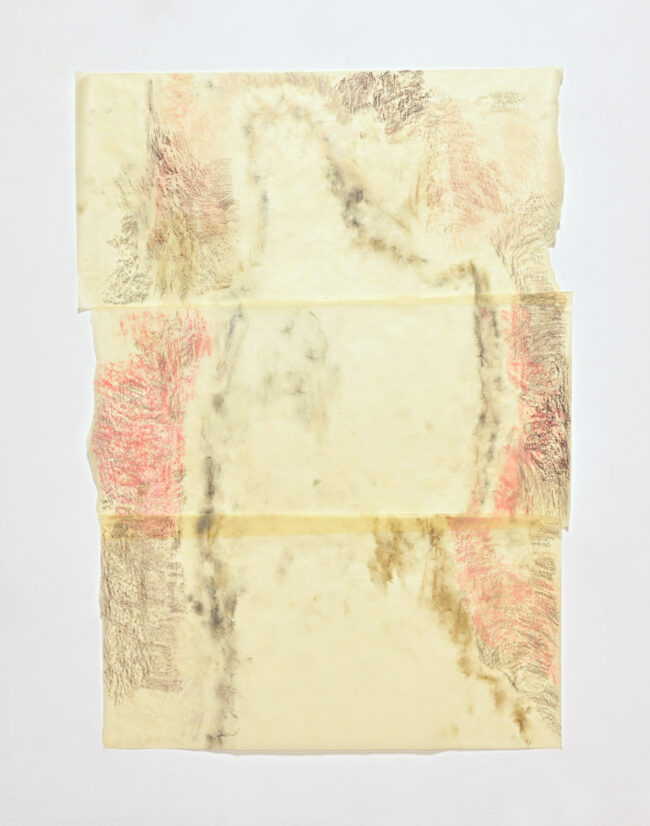
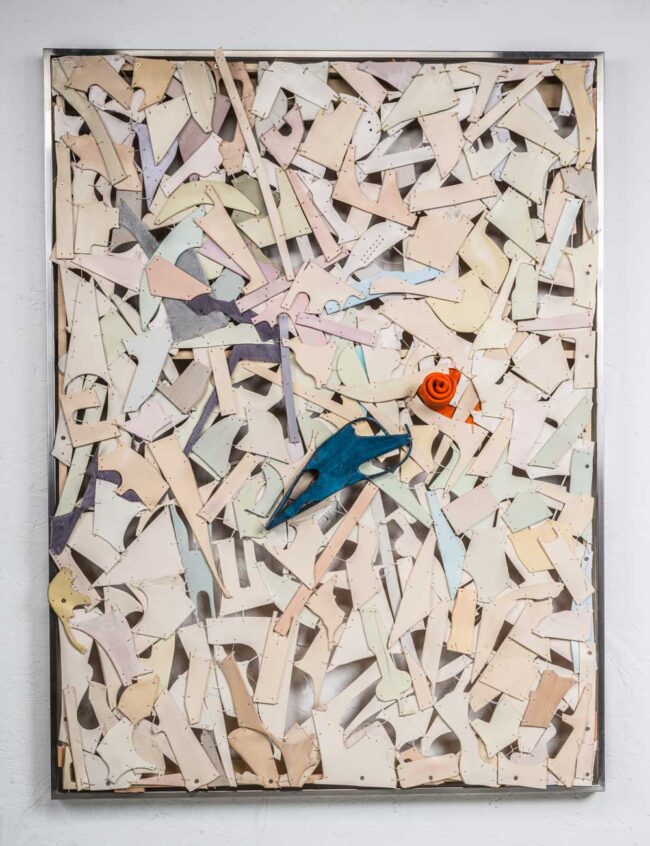
Emily Weiskopf (b. Syracuse, New York) is an interdisciplinary artist, educator, and researcher based in Connecticut. She received a BFA from the Hartford Art School (CT) and an MFA from the Tyler School of Art and Architecture (Philadelphia/Rome, Italy). Weiskopf’s work has been featured in Artnet, Gallerist NY, and The Brooklyn Rail, and has been exhibited with M. David & Co. (NY); Spring Projects (NY), Shin Gallery (NY), Tiger Strikes Asteroid, and White Columns, among others. She was nominated for the Rome Prize in 2011 and awarded residencies at the Vermont Studio Center (2011, 2021), the Wassaic Project (2012), the Atlantic Center for the Arts (2023), and ECOCA (2024). In 2021, she was among the ReClaim Award winners in Cologne, Germany. She is currently developing a permanent public artwork for the City of Austin, Texas, scheduled to debut in Fall 2025. Weiskopf serves as Chair of the Curatorial Committee at the Ely Center for Contemporary Art and lectures at the Hartford Art School (University of Hartford).

Genesis, 2024 [Detail]

Tau Lewis

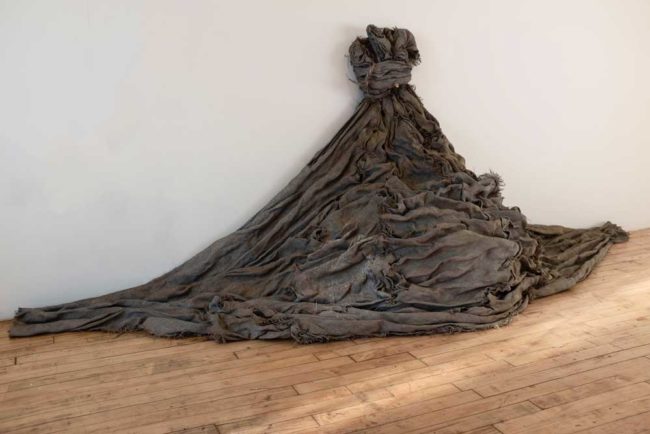
Tau Lewis (b. 1993, Toronto) is an artist who lives and works in New York. Lewis uses intricate craft processes to transform found textiles into monumental artworks, building a unique iconography informed by African diasporic communities in an act of agency, resistance, and healing. Lewis employs the conceptual possibilities of textiles and their real and imagined lineages—considering the past lives of the materials and how their history manifests in their physicality—as a regenerative process through which to examine identity, the body, interdependence, and shared histories. Lewis transforms these recycled materials into large-scale figurative works and likens the practice of upcycling to African diasporic methods of art-making and survival, situating her work within the deep history, vibrant present, and oracular future of Black cultural production.

Uncertain Journey, 2016/2024

Chiharu Shiota

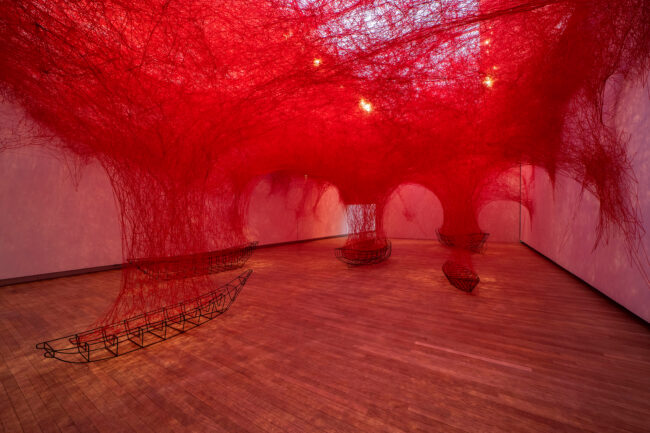
Chiharu Shiota, born in Osaka in 1972 and based in Berlin, draws inspiration from personal experiences and emotions, exploring universal themes such as life, death, and relationships. Through immersive thread installations enveloping everyday objects like shoes, keys, and dresses, she investigates the idea of “presence in absence,” conveying intangible emotions in sculptures, drawings, performance videos, and photographs. Awarded the Minister of Education, Culture, Sports, Science and Technology’s Art Encouragement Prize for New Artists in Japan (2008), Shiota’s work has been showcased in prominent institutions globally, including the Grand Palais, Paris (2024), Hammer Museum, Los Angeles (2023), ZKM, Karlsruhe (2021), and Gropius Bau, Berlin (2019). She has participated in notable exhibitions like the Sydney Biennale (2016) and represented Japan at the Venice Biennale (2015).

if I say the sky's small arithmetic its inscription, its echo

Keli Safia Maksud

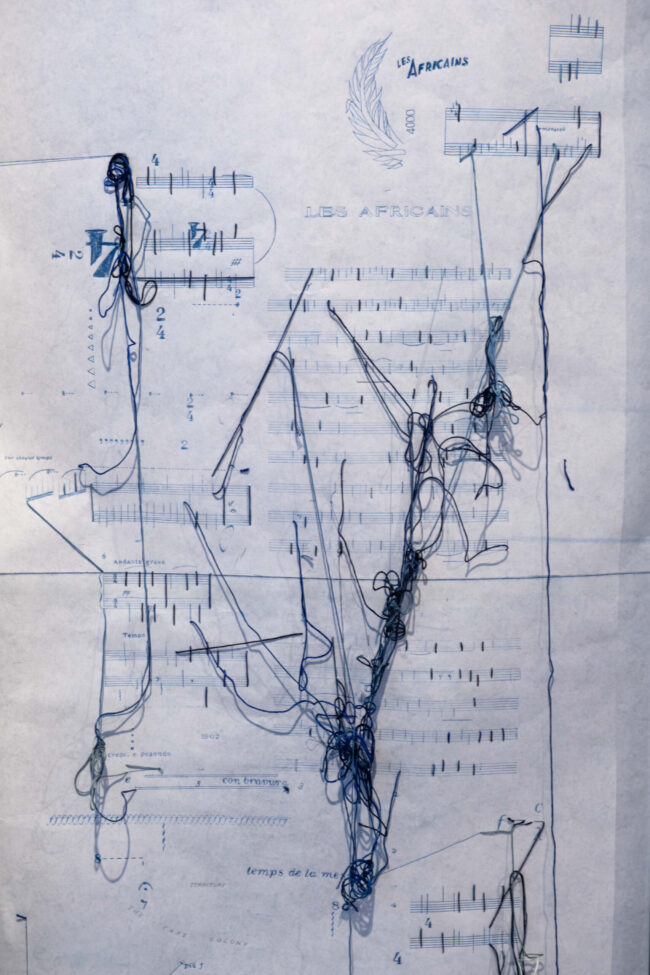
Keli Safia Maksud is an interdisciplinary artist and writer working in sound, sculpture, installation, text, printmaking, and embroidery. Concerned with histories of colonial encounters and its effects on memory, Maksud’s practice favors the space of in-between and its threshold and works toward destabilizing received histories in order to expose fictions of the state. Maksud earned her BFA in painting from the Ontario College of Art and Design University, a diploma in art and curatorial studies at the New Centre for Research and Practice, and an MFA in visual arts at Columbia University. Her work has shown at the Cue Art Foundation, Goodman Gallery, Salon 94, Huxley Parlour, Bamako Biennial, National Museum of Contemporary Art−Seoul, Galería Nueva, and the Biennial of Contemporary Art Sesc_Videobrasil.

The Shiftless Countryside of Emancipation, 2024

Kara Walker

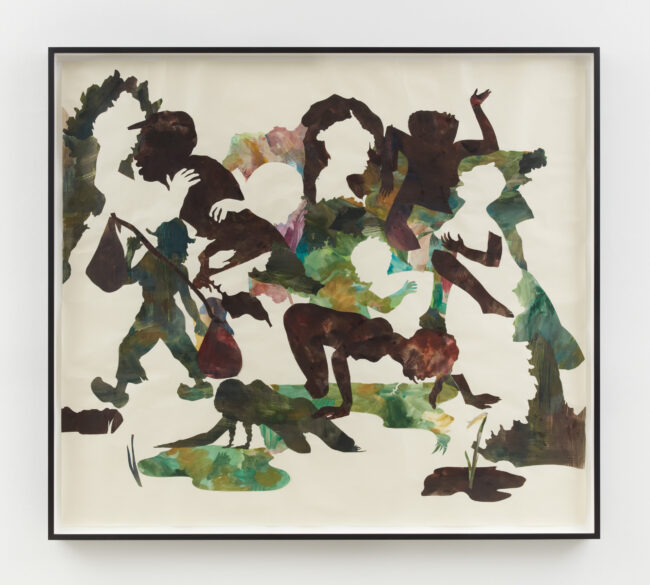
Kara Walker was born in Stockton, CA, in 1969, and raised in Atlanta from the age of 13. She received her BFA from the Atlanta College of Art (1991) and her MFA from the Rhode Island School of Design (1994). She is the recipient of numerous awards, including the John D. and Catherine T. MacArthur Foundation Fellowship Award in 1997, and the United States Artists Eileen Harris Norton Fellowship in 2008. She was inducted into the American Academy of Arts and Letters in 2012 and became an Honorary Academician of the Royal Academy of Art in London in 2019. Her work can be found in the collections of prominent institutions worldwide, including Kunstmuseum Basel; The Metropolitan Museum of Art, New York; Museo nazionale delle Arti del XXI secolo (MAXXI), Rome; The Museum of Modern Art, New York; Smithsonian American Art Museum, Washington, DC; Tate, London; and the Whitney Museum of American Art, New York, among many others.

Abidemi Olowonira

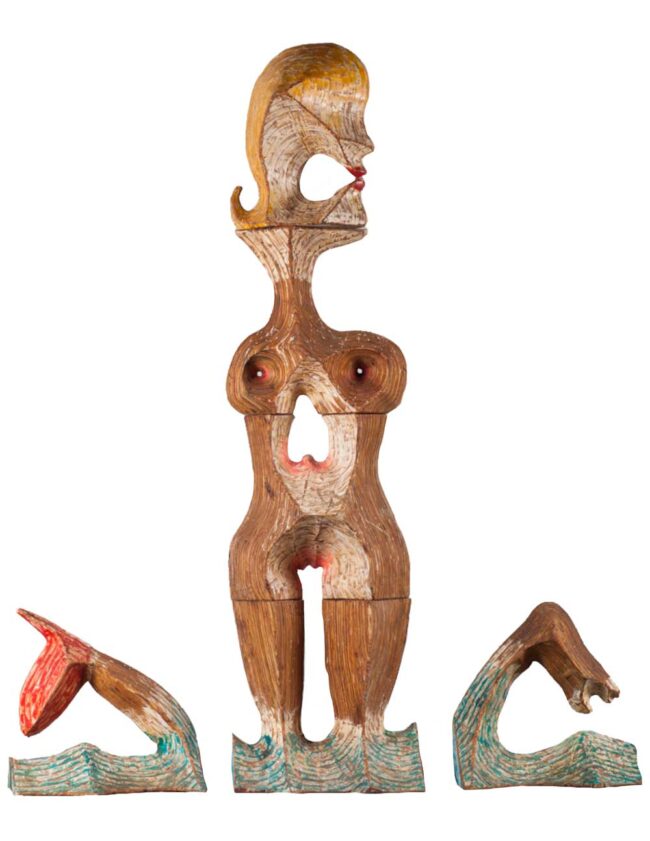
My works are engaged in a dialectic discourse, which finds grounding in transcultural dynamics, a notion that enables me to frolic in the nerves of globalism, as both migrant and human, while using my works as a platform to narrate my story within a larger story. Growing up in Lagos, Nigeria, with its rich history of sculptures and contemporary regenerative arts, I was able to get my first art lessons in my grandma’s tie and dye workshop. The experiences I have absorbed in my travels have also impressed upon me not only a wide range of sensibilities but a trove of material to use when conveying my artistic vision: living in Texas, I was exposed to leather as a medium of expression while working as a gun-holster designer. Then, during my travels, I was exposed to both Chinese and Arabic calligraphy in the two and a half years I spent in Central Asia and the Middle East. Ultimately, my goal is to explore the concept of storytelling through the nuances of modernity while exploiting space, shapes, and voids, and enhancing these elements with the luminosity of light, to create a metaphors around the human experiences. I intend to continue using leather, a pliable and durable material, to promulgate—however subtle that might be—a version of a modernist concept. My intention is to layer and infuse this concept with my multidimensional outlook.

Siren

Ray Smith

Smith produces exuberant paintings and sculptures characterized by an inimitable style and subject matter that reflect his bicultural American and Mexican heritage. Contorted and morphed figures recur throughout his work, in a hybrid that draws from his early studies of fresco painting with traditional practitioners in Mexico, and an indebtedness to Picasso, the Surrealists, and the politically daring Mexican muralists. Through these varied beings, Smith reflects upon the complexities and absurdities of society, family, politics, culture, war, and the human condition itself, framed by birth and death.

Mohamad Khayata

The paintings, drawings, and photographs that make up my practice grow out of close observation of my surroundings, an awareness of the past, and memory. I am fascinated with the materiality of color and light, the mysteries of proportion and scale, and the relative and often great distance between two points in close proximity to each other. It is my hope to make present in the work the moments of equilibrium, the rhythms of disclosure, and the different realities that I discover in the act of looking and making. I hope these discoveries, evolving over time, will prompt recognition on the part of the viewer, as they have in me.

David Bloch

The paintings, drawings, and photographs that make up my practice grow out of close observation of my surroundings, an awareness of the past, and memory. I am fascinated with the materiality of color and light, the mysteries of proportion and scale, and the relative and often great distance between two points in close proximity to each other. It is my hope to make present in the work the moments of equilibrium, the rhythms of disclosure, and the different realities that I discover in the act of looking and making. I hope these discoveries, evolving over time, will prompt recognition on the part of the viewer, as they have in me.

Admire Kamudzengerere

Admire Kamudzengerere’s work explores identity, politics, and society, often informed by the multifaceted structural and social issues that have marked Zimbabwe’s last decade. Working in various media, he frequently reveals an unequal world in which the powerful ride roughshod over the weak.

Jan Cunningham

The paintings, drawings, and photographs that make up my practice grow out of close observation of my surroundings, an awareness of the past, and memory. I am fascinated with the materiality of color and light, the mysteries of proportion and scale, and the relative and often great distance between two points in close proximity to each other. It is my hope to make present in the work the moments of equilibrium, the rhythms of disclosure, and the different realities that I discover in the act of looking and making. I hope these discoveries, evolving over time, will prompt recognition on the part of the viewer, as they have in me.

Reuben Sinha

Traversing boundaries, cultures gained and cultures lost, and sensations across time and space are continual themes in my work. I left India at age eight and, ever since, have worked to reconcile what has been lost and found. My work is a continual meditation on memory and the body using line, color and form. Each work begins with raw materials: wood panels cut from prefabricated doors, beeswax from local farms, damar crystals and basic color pigments. In natural light, these paintings carry a translucency created by pigments suspended in beeswax, evoking sensuousness, depth, and personal reflection. In 2018, I began a series of brown encaustic color studies to explore the limits of a single color’s expression. The series is a response to mass disenfranchisement under Trump and growing xenophobia against brown skin. To some, brown is beautiful. To others, it is dirty; the outsider, the enemy. These color studies mirror the skin of the NYC public school students I teach. By layering and blending loving and hateful associations to “Brown,” I have developed a personal meditation on Otherness. These meditations on “Brown” have naturally incorporated expressions of isolation, anxiety, and calm emerging from the COVID-19 pandemic.

Mia Muratori

For me, artmaking is the documentation of what I see and seek to understand. Watching, synthesizing, recording, I lay it all down with paint, no words, just light, color, shape and space.

Francesca Schwartz

I am interested in the word, the image, the symbol. I am in love with bone. I am fascinated with the body and the end. The body is an impermanent landscape which we cannot truly know until we have also contemplated its disappearance. Part of this encounter rests on inhabiting my body as a woman. The blood flows mysteriously and then departs, marking seasonality. I meditate on corporeality and femaleness. Always the questions: What does the body retain? What is encrypted? What is memorialized? I am drawn to elements of bone, dye, chiffon, paper, wood, and found objects. I like some materials for their precision, others because of their elusiveness. Once in hand, alchemy takes over, and what happens is unexpected. So it goes, as the unconscious emerges. I tear apart, unravel, and desecrate in an effort to get to the center. I collage to bring cohesion to what feels fragmented. I assemble what is fragmented within myself and those I have lost. I devour. I cannibalize. I resurrect. By altering and reassembling the image, I encounter the space between longing and loss, memory and erasure, permanence and dissipation. I inscribe experience, even as it recedes. The body is inscribed; the word is written. We linger in some ways, yet we are destined to vanish. I bear witness while I am here.

Grace Bakst Wapner

Grace Bakst Wapner’s work with urethane or satin, clay or bronze, chiffon or pipe cleaners in an interactive dialogue between material and object has been determinative in her process. In the early 1970s she erected walls and barriers constructed from satin and velvet, alluding to the dual nature of our social interactions, and now, in the 2000s, after working for years with clay and bronze, on paper and on canvas, she has returned to working with fabric, sometimes conjoining the fabric with clay. Throughout, there has been a continuing belief that the implementation of color, line, texture, and form
can evoke abstract truth. She studied painting and sculpture at Bennington College and at Bard, where she participated in the MFA summer program. But it has been her intensive day-to-day studio practice and the looking at the work of other artists that have most significantly informed her work. She has had twenty-nine one-person shows, participated in over one hundred group shows, lectured and taught, and been the recipient of honors, grants, and awards. She believes that the singular and complex practice of making art both asserts and affirms our humanity.