
On This Land
by Laura Farha
On this land, is what makes life worth living
—Mahmoud Darwish
5 April 2026
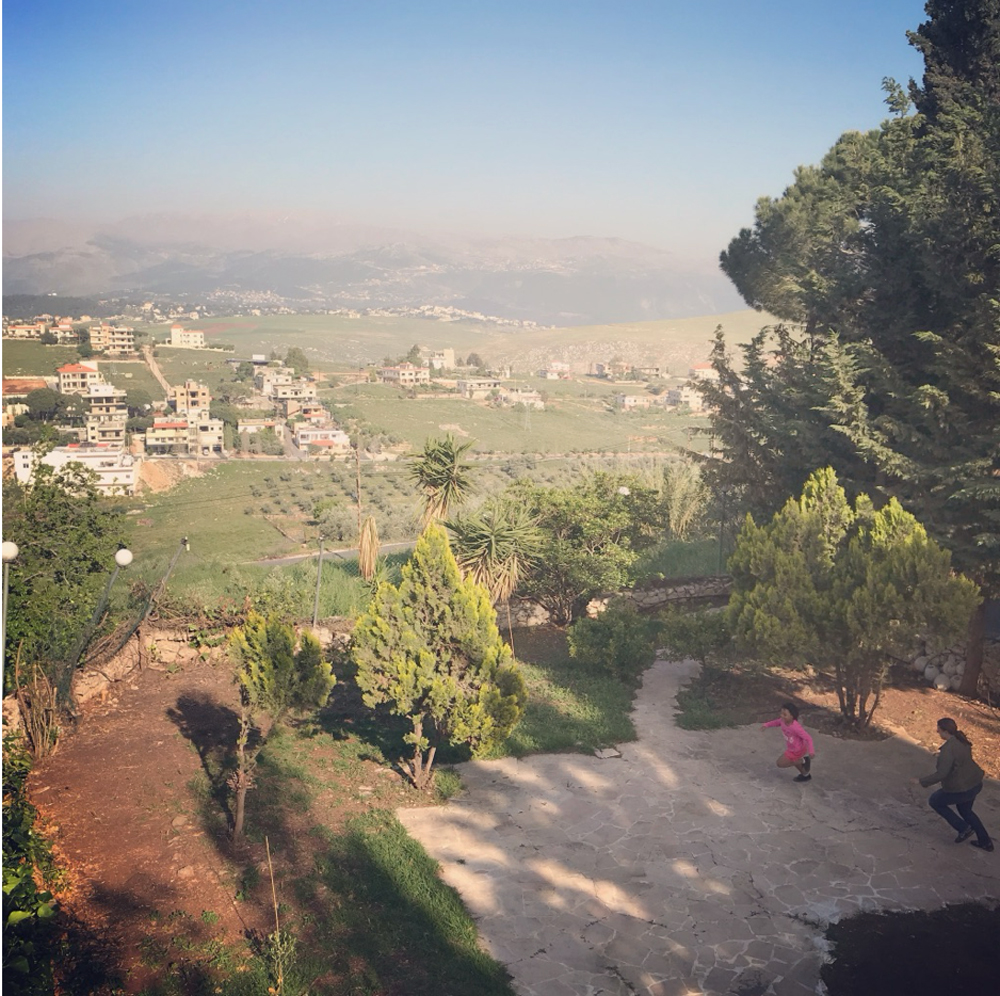
My patient and I, both presently in the US, are originally from neighboring villages in south Lebanon. She, Shia from a predominately Shia village; I, Orthodox Christian from a mixed village. I can see her village from the veranda of my three-hundred-year-old ancestral home. It’s a view that I know and love well.
I weep while FaceTiming with my cousin who is unable to sleep during intense shelling. I attempt to comfort him, to witness and bear his despair. He asks if I can hear the explosions that rock and destroy, he does not know what. Won’t know what has been broken until dawn itself breaks. I feel I fail him when I tell him the truth: I cannot hear what terrorizes him. My cousin, seventy years old, refuses to abandon our home and village. He remains alone in his home.
My patient’s village has been nearly destroyed by Israeli bombs. Only a handful of people remain, mostly very old women and men who refuse dislocation. We share a deep love and connection to our respective villages and ancestral homes. We both have dreamt of returning, she to open a school, I to retire and raise goats. Once, she returned from a visit home and brought me an olive branch from my village, in a period of intense bombardments when I did not know if I would ever be able to return. I wept with pain and gratitude for this priceless gift and our wordless understanding of its meaning.
Things are unfathomably more hopeless now. Israel’s defense minister, Israel Katz, and finance minister, Bezalel Smotrich, are planning to re-occupy Lebanon up to the Litani River. They vow to drive out residents and destroy every home. This beloved river, thirty kilometers from our southern border, welcomes the Lebanese to the south. Since 2023, Israel has escalated its use of white phosphorus in south Lebanon, a notorious and unlawful scorched-earth tactic to clear the land of vegetation and other life forms. The people of the south resist and refuse submission.
During the Ottoman Empire, when Christians were under attack, my maternal family was spared by a Muslim neighbor. My great-grandfather, a butcher, was known in the area for giving meat to poor families in need, regardless of their sect. The Ottomans conscripted young Lebanese Muslim men and boys into their brutal army, and one such boy was ordered to participate in a massacre of Christians in our village. As they were rounding up Christian families, the boy recognized my great-grandfather and remembered him as a generous and humble man. Somehow this young, reluctant soldier got word to my great-grandfather, instructing him to take his family and hide. His act of courage saved my family. Saved me.
Despair accumulates. The latest news is of predominantly Christian villages in the south being directed by Israel to prohibit Shia Muslims from seeking refuge. This ultimatum was given to the authorities in my village. We are entrapped into an ethnic cleansing of our kin. In return, the Israeli military promises to spare our people and villages from utter annihilation, the fate they are imposing on our neighbors. It is not the first time our villages have been placed in such a wrenching double bind. Neither is it the first time Israel makes and breaks such promises. It’s Sophie’s Choice, with Israel playing the part of the Nazis.
A few days ago my patient’s home was destroyed by Israeli rockets. She shows me a photo of the smoke and rubble, the corpse of a home, on land that endured countless Israeli bombardments yet continued to give life to olive trees. Her home, a refuge and a beacon of steadfast love and resistance. Her past and her future, obliterated. She is bereft. We squint to see its remains from the photographer’s distant vantage point. I recognize it: it was taken from my village, not far from my own broken but still-standing home.
If my patient knows the extent to which Israel is bent on driving a wedge between her people and mine, she doesn’t mention it. I haven’t mentioned it either, but I wonder what it will mean for us, for her treatment, for our relationship.
Postscript 1
8 April 2026
“Operation Eternal Darkness” is Israel’s name for today’s attack on the whole of Lebanon. 160 bombs in ten minutes. 160 bombs in ten minutes. We live in a post-genocide era. There are no limits; there is no stopping them. In Lebanon, an exhausted, shattered people begin to turn against each other.
Postscript 2
17 April 2026
Today begins a ten-day ceasefire. The roads to the south are jammed with Lebanese families returning to their villages. So long as there is breath, there will be steadfast resistance to occupation. The connection between the people and the land is indestructible. The light returns.
On this land, is what makes life worth living.
- Laura Farha, MDiv, LCSW, is a psychoanalytic psychotherapist with a private practice stretching from Berkeley to Beirut. She works primarily with people who navigate life through multiple cultural systems. Trauma, displacement, dislocation, and the shaping effect of the social on the unconscious are important ideas that influence her thinking and work. Laura is a co-founder of the Beirut Institute for Psychoanalytic Psychotherapy, a member of American Middle Eastern/North African Psychological Association, and a steering committee member of the Coalition for Clinical Social Work.
- Email: laura.farha@gmail.com
ROOM is entirely dependent upon reader support. Please consider helping ROOM today with a tax-deductible donation. Any amount is deeply appreciated. |