
We Are the Light: No. 4
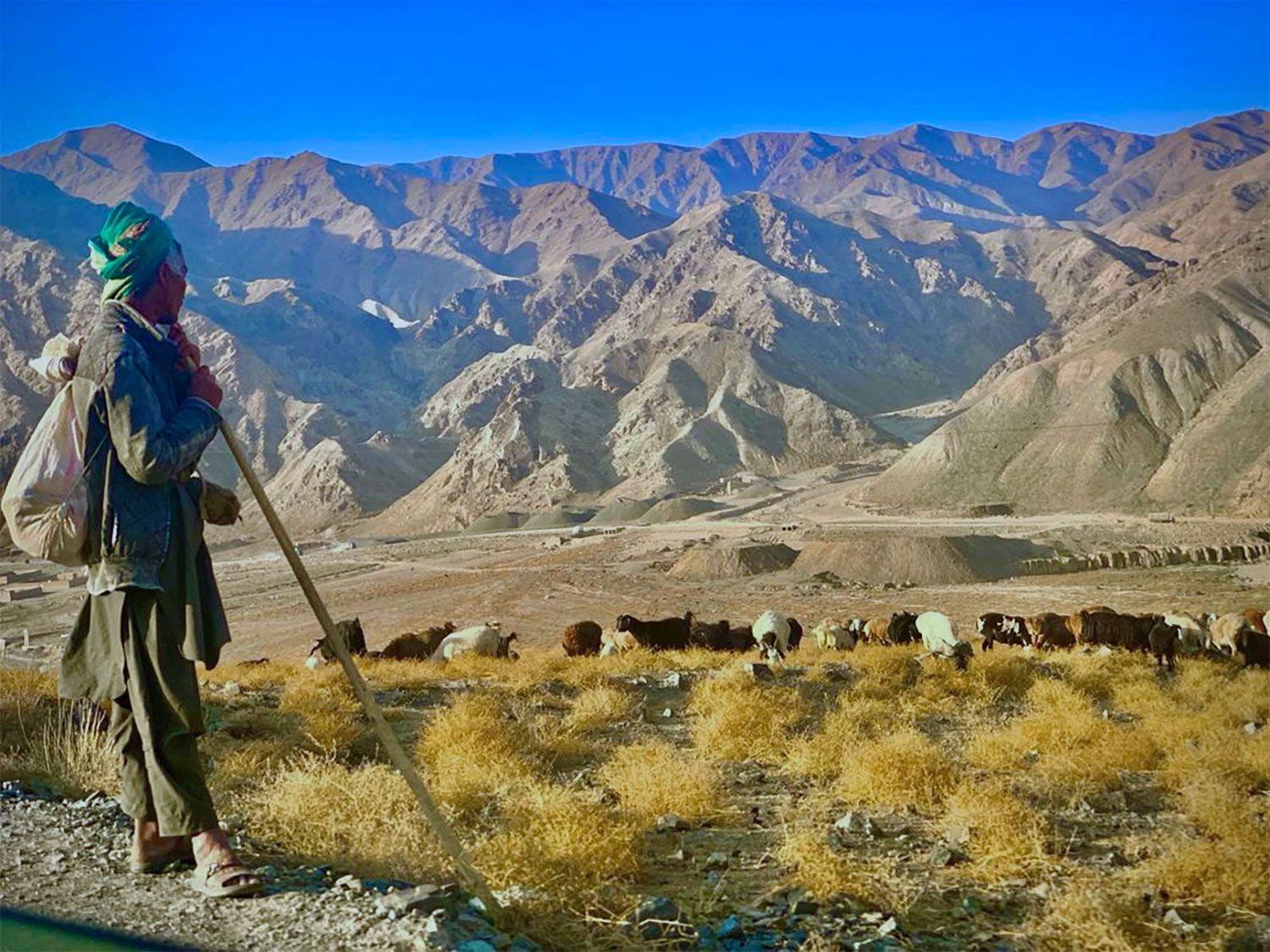
The Shepherd
Pen Name: Shaparak
Nation: Afghanistan
Age: 26
Photo Essay
Artist’s Statement: My pen name is Shaparak. I am from the country of Afghanistan, a place where the voice, appearance, and identity of girls are their biggest trouble. But they are still hopeful for the future and for good days. Life here is hard and unbearable, but our beliefs are for us like a path of light. I am a smiling girl who is committed to her life goals and beliefs. I stand firm. For some time now, I have turned to painting and photography, despite all the restrictions and challenges, not just to save myself from daily routines but rather as a way to continue to use my voice and not be silenced for my opinions.
Around the cold days of last autumn, together with my family, we were going toward my birthplace. On the way, I took photos of everything that seemed beautiful to me, for example the people, the road, the trees, the river and so on.
On one part of the road, I faced a very heartwarming scene that caught my attention and was truly worth seeing. Even now when I browse my gallery, I go back to that day and to that scene. I strongly feel the authenticity of homeland and life in it.
There was a tall thin shepherd with a wrinkled face and messy white hair who was completely dressed in simple traditional clothing. His green scarf caught my attention even more. It suited him so much.
For a moment I placed myself in the space beside him. I was thinking about how this shepherd lives his life in daily routines far away from the noise of our world.
I was thinking about what he thinks about. Maybe about the number of his flock which is going to have new lambs that he will carry and how dear they are to him. Maybe about the lack of water and fodder. Maybe about the fierce wolves who might tear his flock apart if he becomes careless. What is the name of his most beloved lamb? Does he sometimes talk to them like the story of the shepherd in the book The Alchemist?
Has he ever asked himself, Why should I be a shepherd? Why not a writer or a painter? Why not a trader or a doctor?
Or does he think, “I was born to become a shepherd.”
And all his worries are only about the fierce wolf and how he should protect his sheep. Or maybe he thinks about nothing at all and has let himself flow in the course of his life and life is that simple for him.
The Forgotten Self
Author Pen Name: Saje
Nation: Myanmar
Age: 18
From a dark corner of the world,
I used to light up a kerosene lamp
Inside the uncovered and unwalled house
The brutal wind blew it out and darkened
I wanted light just to recognize myself
From a yellow garden plant,
I used to bloom a fragrant flower
The plant was ignored and unwatered
The bud born fell down before it bloomed
I needed nourishment to blossom
From the void of a vast desert,
I wandered toward my destination
No oasis appeared, only storms of grit
Lost in direction, unlike even a Bedouin
I longed for a path that would lead to my destiny
From the battlefield of a genocidal land,
I sought refuge; my heart still beating.
With bleeding wounds and burning scars
I reached beneath the tarpaulined shade
I longed for peace, peace and peace again
Years upon years, I have remained unrecognized,
Unable to see myself, restricted and denied
Living through pain, sleeping in nightmares
I no longer knew who I was
Except “Rohingya,” the name the world calls me
The Girl with the Borrowed Light
Author Pen Name: Haya Iman
Nation: Afghanistan
Age: 24
In the corner of a small, old house in Baghlan, under a clay roof, 16-year-old Laila sat with her knees pulled to her chest, her mother’s old scarf wrapped tightly around her head. A secondhand phone is in her hands, the only light in the room besides the flame of an old lamp that is going out.
The internet signal was blinking. She tapped the screen several times. The page wouldn’t load.
Laila sighed but didn’t cry. She had already learned that tears didn’t fix broken connections or dying batteries. She counted silently – ten seconds, twenty – until the internet on her mobile finally worked.
A face appeared. A teacher from another country. A soft voice greeted the students. And for the next fifty minutes, the world outside faded. No gunshots. No limitations. No news headlines. Just the steady rhythm of learning art, English words, and dreams that were beyond the narrow walls of her life.
Every day, she borrowed the phone from her uncle who lived next door only for one hour. It wasn’t enough, but she had learned to make it work. Before class, she would spend her mornings helping her mother weave rugs. After class, she would teach her younger sister what she had learned. And at night, she repeated her lessons and tried to get ready for the next day’s class. She wanted everyday to speak in the class and would share her thoughts and ideas enthusiastically with her teacher. Maybe because she was forbidden from speaking in public, she was not allowed to raise her voice. She was teaching herself to become a teacher.
Laila still remembered the day school was banned for girls her age. She had come home with books in her bag and dreams in her eyes. By sunset, both had become forbidden.
At first, she was angry. Then numb. Then determined. She found Telegram channels sharing lessons. YouTube playlists in Dari. PDFs of textbooks. She had no formal exams, no certificates, no one to pat her back and say, “Good job.” But she showed up every day anyway. In silence. In shadows. In secret.
And even though the world outside didn’t see her, she saw herself.
In the mirror, she didn’t just see a girl stuck in a room. She saw someone training to be free.
Her friends called her “the girl who borrowed light”, not just because of the phone, but because of the way she spoke. The way her eyes sparkled when she explained something she had learned. The way she believed in a future that felt impossible.
One night, the internet cut out completely. Her class went on without her. She sat in the dark, staring at her notebook, and for a brief moment, she felt the weight of the world pressing down on her chest.
Then her little sister climbed into her lap and said, “Can you teach me that poem again? The one from Rumi’s Masnavi?”
“هر کجا ویران بود آنجا آمید گنج هست
Where there is ruin, there is hope for treasure.”
Laila smiled. Because even without a screen, without internet, and without the light, she still had hope. And with that, she passed on the one thing no one could ban, block, or take away from her:
hope
Dark shadow
Author Pen Name: Baran Rasoul (March 2025)
Nation: Afghanistan
Age: 26
The cruelty of the Taliban is a dark shadow that casts over the light of hope. Even the darkest nights come to an end. Oppression wants to silence voices, but the truth can never be hidden forever. Hearts that have endured pain understand more deeply.
…
When I remember three years ago, my hands start to tremble.
I lost the most valuable things in my life — my father, my education, my love, and the home that held all my childhood memories.
We had a very happy life, every moment of which holds a beautiful memory.
We lived in one of the provinces of Afghanistan. When the Taliban came, the disasters they brought upon us will never be forgotten. My father worked in a government institution. A week before the fall of Afghanistan, my father was threatened. He was very frightened. He came home in a hurry and said, “No one should leave the house.”
The Taliban had threatened my father that they would kill him, along with his family. From that day, he had no peace. All the provinces of Afghanistan were at war. No one knew that, with the coming of the Taliban, the lives of some families would be turned into dust. The oppression of the Taliban is not only taking away rights, but silencing the voices of generations.
Ah, my dear father. My father is still alive in my memory.
One morning, my father left the house. Not long after, he returned and said, “Afghanistan has fallen.” My father was very scared and could barely speak. He said everyone should get ready because we were going to Kabul — the Taliban had taken over everywhere, and the situation was terrible — we had to escape. But we found no way to flee. That night, I could not sleep out of fear. In the morning, my father said he would go to find a car so we could escape to Kabul. That day was the last time we saw him.
The Taliban captured my father. After a few days, the news came that they had killed him, bringing a storm of sorrow into our lives. For three years, I have not been able to extinguish the fire of grief in my heart. We had not yet digested our sorrow when some men came to our door and said that if we wanted to stay alive, we had to leave the province. The next day, we were threatened again by the Taliban. It was a terrifying day. We left our home and spent the night in the house of some relatives. In one week, I lost two of the most important things — my father, and the home that held all my childhood memories.
More loss came. Even now, when I hear the name of the person I loved so deeply, my heart aches. It was the first time I had ever fallen in love. He was study ing abroad. He sent me a message saying, “The Taliban have taken Afghanistan. I don’t want to return to the country anymore. You are free; go and build your future.” When I read that message, I felt as if the whole world had collapsed upon me. No matter what I did, night would not turn into morning.
Soon after, we escaped to Kabul — to a city where I knew no one, in a government where no woman has any value. They said the Taliban take unmarried girls for marriage. Wearing a burqa out of fear, we came to Kabul. The Taliban destroyed the dreams of all Afghan girls. I wanted to continue my education, to become a successful lawyer for my society. But I became a bird without wings, imprisoned inside a cage.
The problems that came made me tired of everything in life. I had chosen only one lonely path. At night, I used to stand by the window and cry, thinking that maybe a day would come again when I could fly once more and reach the dreams I have. One of my friends, who knew about all the problems the Taliban brought into my life, introduced me to a woman who rebuilt me. The heart that was broken slowly began to heal.
I rarely used social media. One day I went online and saw a message. It said, “Hello, your number was given by friends.” Even though I had no desire to reply, unconsciously I answered the message. I greeted her and introduced myself. It was a woman who spoke to me with a pure heart and sincere intentions. This woman was helping Afghan girls. Since the Taliban closed all the school doors to girls and silenced the voice of freedom with the force of guns, mothers’ hearts were filled with fear and despair.. Girls were deprived of education. She created an opportunity to make the silent voices of women and girls, who have no rights in Afghan society, heard by the world.
From the day that woman sent me a message, a feeling grew in my heart — a feeling that pulled me toward her. Every day I would message her, and we talked a lot. Until one day she said, “Why do you message me so much?” I told her, “Messaging you gives me a special feeling. If I’m bothering you, I will stop.” She said, “No, not at all, you can message me.” She was so kind.
She gave me so much hope for life again that I started to stand up once more, not to kneel before problems, because I know life is never easy. I wiped away my tears and embraced hope again.
I have made that woman my role model — to be kind, compassionate, and strong like her, to never forget to smile even in the hardest moments, to always support others even when she herself is tired. She taught me that being a woman means having the power of patience and hope in the heart of darkness.
ROOM is entirely dependent upon reader support. Please consider helping ROOM today with a tax-deductible donation. Any amount is deeply appreciated. |